

As a designer, often it is challenging to begin. A problem has been laid out in front of you, but how do you start to find the solution?
With Human-Centered design thinking, the best place to start is with empathy. Observe, interview, and immerse yourself in the user’s daily activities. Create an empathy map to help collect your data and give you a visual representation.
“Empathetic research reveals the deeper needs and root causes.”
-Rikke Friis Dam and Teo Yu Siang
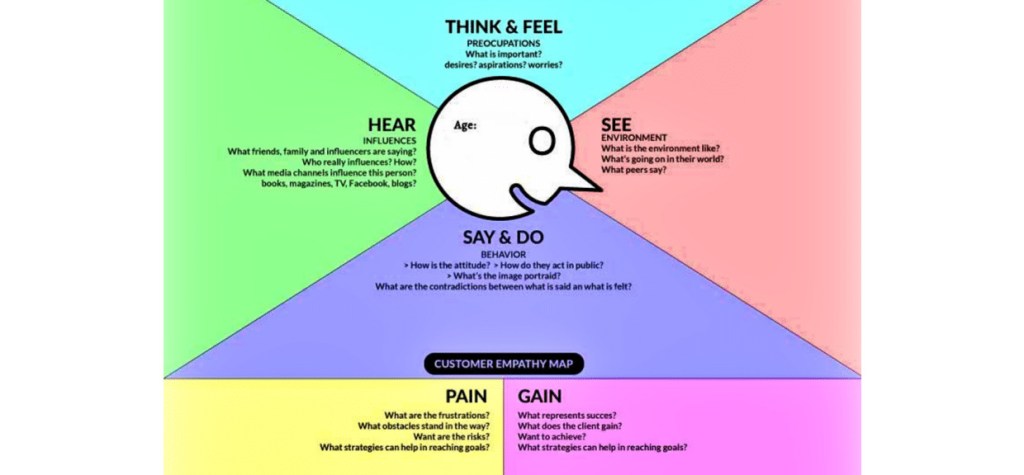
An empathy may help you explore the person you are designing for from different angles. You study what they see, what they’re thinking and feeling, what they’re doing, and what they hear from others. The map also includes what their pain points are and what they are looking to gain. Through this exercise, ideas start to form. Even if they don’t develop, you will have a clearer picture of the challenges you must overcome when designing. Dam and Siang state, “We can only fully understand and design a desirable product or service when people’s needs, experiences, wants and preferences are properly understood.” The empathy map also works to keep you grounded and focused throughout your project. Keep it on display while working and refer back to it frequently.
In a recent exercise, I created two empathy maps while watching an episode of Undercover Boss. The show’s premise is for a Boss to gain insights into the inner working of his company by concealing their identity and performing the tasks of a subordinate employee. Experiencing what others go through is a great way to gain understanding and empathy. The episode I watched featured the CEO of TGI Fridays, Ray Blanchette, who struggled to figure out what the company needed to prosper. Blanchette worked as a bartender, an assistant manager, and kitchen help. Before the exercise, he thought revamping the menu and creating a “Happy Hour” promotion would help bring more traffic. Later, Blanchette found the solution to the company’s problem is in the success of his employees. He saw that for the company to thrive, he needed to put more energy into his employees. He resolved to increase training, create a better dialog between the corporate office and the restaurants, and give his employees the support they need.
“An empathy map is a quick digestive way to illustrate the user attitudes and behaviors.”
-Sarah Gibbons
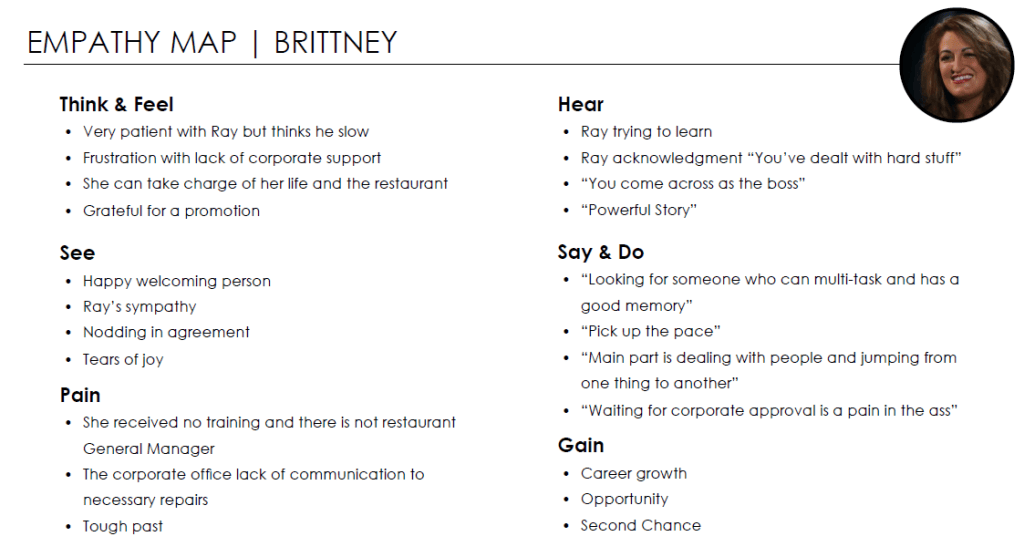
The first empathy map I created was for a frustrated employee named Brittney. My first impression was that she is very friendly and warm, but she was upset by the lack of management and corporate aid needed to run the restaurant properly. On her map, I also show that she is a strong person who knows how to overcome many obstacles personally and professionally.
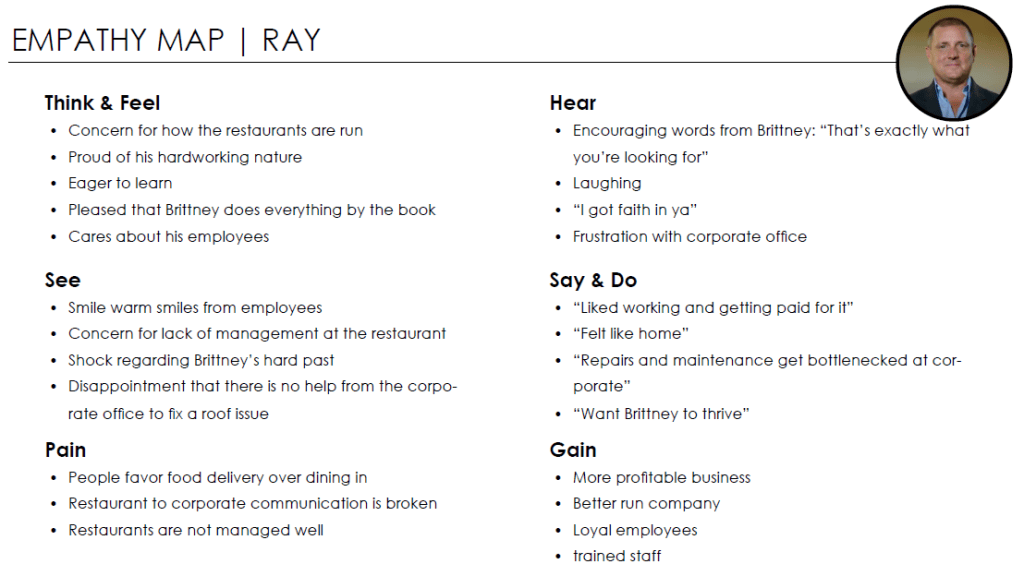
My Second map features “Keith” the undercover persona of Blanchette. He was compassionate about his work and genuinely looking for ways to help the company succeed. Refreshingly, he found the best way to help TGI Fridays is by helping his employees personally and professionally. Blanchette was able to see and understand his employees’ needs, thus finding the root of the company’s issues.
Conclusion
Empathy is a quality we all possess. All we have to do is remove any bias, be open-minded, and observe. When watching others, our brains act as if we are engaged in the activity we see. Conducting empathetic research helps designers go deep and find the root cause of the problem. “We can only fully understand and design a desirable product or service when people’s needs, experiences, wants, and preferences are properly understood.”
Click here for my complete empathy mapping presentation

 To Mulberry Street Marketing & Design
Leave a comment