

Designers are challenged every day to solve problems and produce out-of-the-box ideas but that isn’t always easy. There is no bank where you can cash out unique ideas or a tree that grows beautiful solutions. Instead, you need an open mind, inspiration, and a few ideation techniques.
“Ideation is the process of generating a broad set of ideas on a given topic, with no attempt to judge or evaluate them.”
Aurora Harley
The purpose of ideating is to come up with as many ideas as possible, this way designers can have many ideas to consider. Thankfully there are many methods in ideation, but in this post, I will focus on one, the Mash-Up. This technique was developed by Ideo U and here’s how it works:
- Frame: Create a “How Might We” statement
- Narrow: Pick two categories, One that is related to the problem and the second to something completely different.
- Generate: Set a timer for 2 minutes and list all about 15 elements for the first category. Repeat this process for the second category.
- Mash-Up: Combine elements from each category to create new solutions.
Creating a “How Might We” Statement
After researching and defining the problem, a “How Might We” statement reframes the problem into a question that is actionable and helps spark ideas. Recently, I created a “How Might We” statement regarding the Crossy Roads app. Many players complained that there were too many ads and their game was constantly interrupted. Here is my statement:
How Might We generate revenue for the Crossy Roads app without pop-ups that disrupt the players?
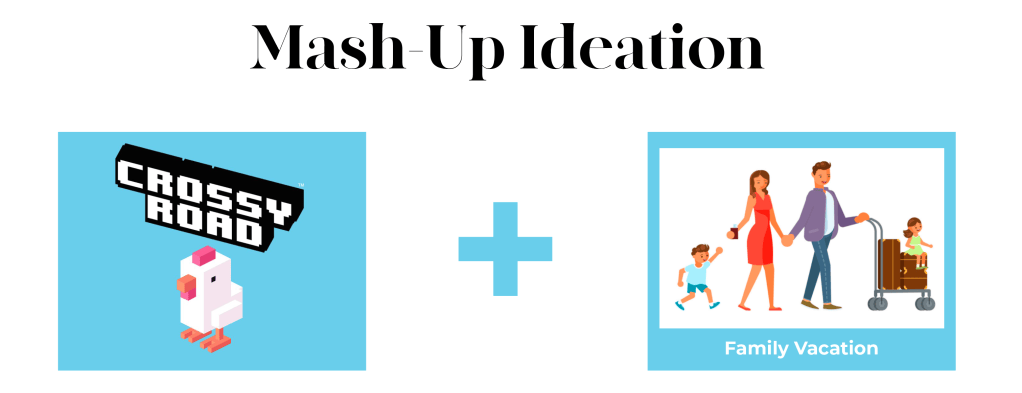
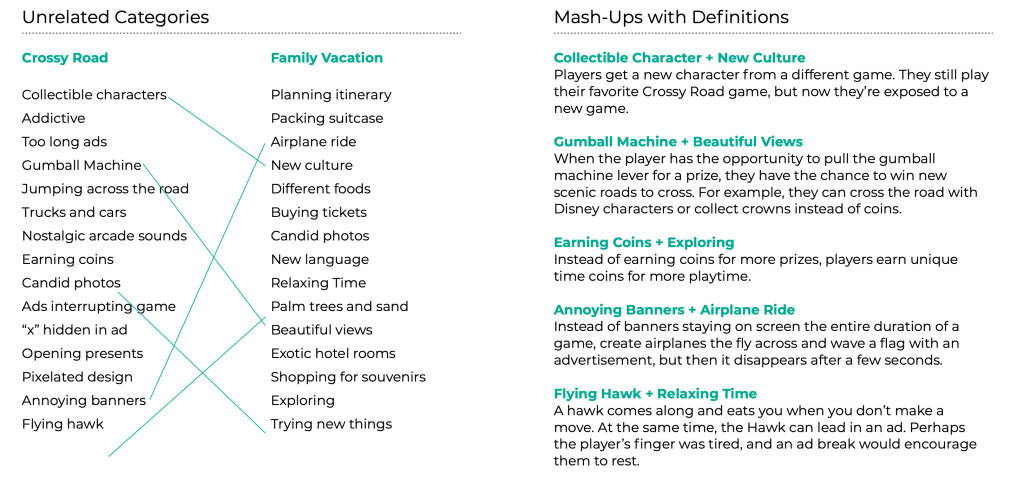
Armed with my statement, I was ready to move on and pick my two categories. My partner and I selected the Crossy Roads app and Family Vacations. Then we began generating the list of elements. These first three steps were relatively easy, but when I came to the fourth step, the mash-up, I realized I choose too many descriptive words and nothing was “mashing up.” I had to go back to step three to generate more concrete details of Crossy Roads and Vacation. Once my category elements were more descriptive, I was able to mashup the two categories. In the end, my partner and I produced five unique ideas.
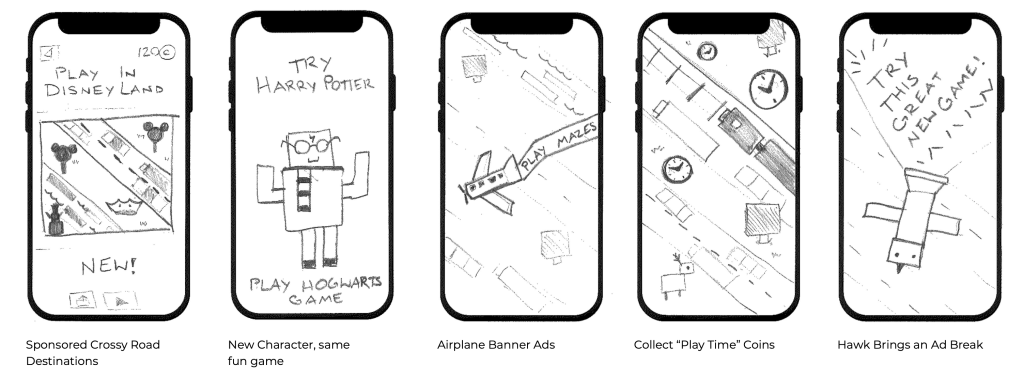
Mash-up ideas sketched out
Seeing the steps neatly laid out makes the process look easy, however, the last step is very challenging. Mashing up the different categories stretches your brain and forces you to flip the ideas in all sorts of directions until you finally work out the problem. This unconventional method is a great way to help look at problems from different angles and generate unique solutions.
Here’s my complete presentation
 To Mulberry Street Marketing & Design
Leave a comment