

What is Content Strategy?
From blog posts to podcasts, social media, email, etc., content strategy is how organizations manage their content for their users while keeping in mind their business objectives. With a content strategy, organizations can create a roadmap for how to reach their audience while still meeting their company goals. A properly laid out content strategy can help determine any company issues, analyze them, then provide opportunities for increased efficiencies and or sales goals. The below video explains how content strategy finds the balance between customers’ wants and needs with an organization’s wants and needs.
The Early Years of Content Strategy
The concept of content strategy has evolved. In the beginning, content strategy was more about creating structure and ways to organize published materials (or content). Sometimes the organization involved created a manual that broke down complex instructions into smaller pieces. Eventually, in the early 1980s, software such as FrameMaker was developed to make the structure necessary to organize all the information.
Later the formation of the internet changed everything, and models for organizing media began to develop to the point where large web companies started creating dedicated “content strategy” positions. Not long after, in the early 2000s, the idea of content strategy as we know it began to take off. First, books were written, then a dedicated website, contentstrategy.com, was registered, and later in 2005, an XML standard (DITA-Darwin Information Typing Architecture) was developed. The DITA standard was developed to help people “author, manage and publish topic-based content at a scale.”
Content Strategy Takes Off
With information technology standards in place and the world wide web expanding, Content Strategists and tech and management teams came together and began hosting conferences, the first-ever being in 2008. At the same time, more books were written on the subject, and web forums and groups started popping up. As a result, content strategy was becoming more popular.
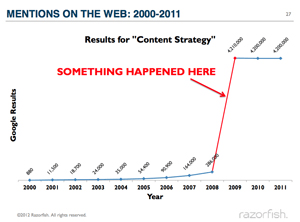
Between 2008 and 2009 is when the idea of content strategy started spreading. Search results on google skyrocketed, then meet up’s and consortiums dedicated only to content strategy started. Soon after, the idea began to gain more traction across the globe, beginning in France, then Germany, and England.
Enter Google, Yahoo, and Bing
Soon after 2010, Google, Yahoo, and Bing, the big three search engines of the time, worked to develop a structure to “standardize small units of content called microformats.” This was a momentous step because it allowed for content to be sorted and found more accurately. The organization the big three formed was called schema.org, and is still in use today.
With content strategy expanding, universities worldwide began to notice, and an Austrian school developed the first Master’s Program. As a result, more resources emerged, and experts began writing books dedicated to individual areas within content strategies such as technical content, social media, and localization.
Eight Years Ago
The area of content strategy began to broaden more when in 2013, articles appeared trying to separate content strategy into two categories, the first to define content for its user experience. The second for use in infrastructure needed to automate and scale content. These two ideas are still in play today as content engineering and content operations, although they are very much connected and rely on one another. Simply stated, this shows the field of content strategy is growing, and more facets of content strategy are emerging. Evidence of this can be found when reviewing the number of content strategy positions on LinkedIn. In 2007 there were 7,500 job titles shown; in 2020, there are over 55,000. This trend shows content strategy is on the rise, and more employees in this field will be necessary.
Content Strategy Today
“Content strategy helps organizations provide the right content, to the right people, at the right times, for the right reasons.”
Meghan Casey | Content Strategy Toolkit
Today content strategy has become an integral part of a company’s success. With all of the various ways organizations work to reach their audience, a solid foundation in content strategy is essential to figure out users’ needs and how they align with the company’s goals publishing the information.
In the book, Content Strategy Toolkit, author Meghan Casey breaks down all of the components necessary to create a successful strategy. She explains that these components can be scaled for small projects such as a mobile app or used for complete brand overhauls. Casey outlines these essential elements necessary in developing a content strategy:
- Identify the company’s current issues. Ask questions such as: is the website site undergoing a redesign? Has there been a restructuring of content or a new CMS (content management system)? Or, does the company want to improve efficiency?
- Develop opportunities and areas to improve. After spending time auditing the content and running analytics, you’ll be able to find areas of improvement. Summarize the findings and lay out the solutions and opportunities available to the company.
- Get buy-in from critical stakeholders. Business people think in terms of ROI, explain how the solution outlined can benefit the company financially or create efficiencies. There needs to be a monetary reason showing how the solutions outlined will be beneficial to the company and its bottom line; otherwise, a company will not take the time to invest in it.
- Make a plan and make it very detailed and comprehensive. Outline the project budget, who the key players are, and what roles they will undertake. Create a timeline with benchmark dates and keep a regular schedule of status meetings.
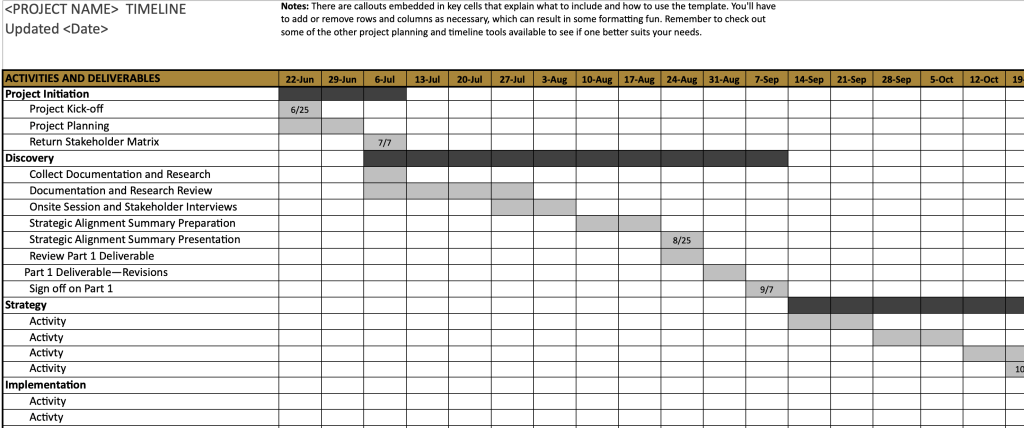
From all of the planning and preparation, the project will be on track for success. Because content strategy is so multifaceted, it is crucial to be very well prepared and organized. The strategy that is under development will become the backbone of all future content, including technology structure and marketing initiatives. As Rober Rose states, “Content strategy is the planning, development, production, governance, evaluation, measurement, and analytics of content that aligns with business goals.” Everything branches off of content strategy.
Wrapping Up
Content Strategy’s basic principle of organizing information has stayed true since its inception. However, with the growth of technology and the internet, content strategy has grown and evolved. Today, content strategy entails providing structure for content, but there is a heavy emphasis on its relations to the people seeking it. With the advent of standardization from DITA and the three large search engines working together to make sorting and finding content more accurate, content strategy has made information more accessible. Successful corporations see the value of dedicating resources to make sure the information they provide reaches the right users and helps grow their business.
References:
Auchettl, Brigid. (2017). Why content strategy is the smart career move for journalists. Future Friendly. Retrieved from https://medium.com/@Future__Friendly/why-content-strategy-is-the-smart-career-move-for-journalists-c576610bc70
Casey, Meghan. (2015) Content Strategy Toolkit: Methods, Guidelines, and Templates for Getting Content Right. Pearson Education. Kindle Edition.
Rose, Robert. (2013). How Content Strategy and Content marketing Are Seperate But Connected. Content Marketing Institue. Retrieved from https://contentmarketinginstitute.com/2013/10/content-strategy-content-marketing-separate-connected/
Toole, Catherine. (2017). Content Strategy vs. Content Tactics (Catherine Toole). NNgroup. YouTube. https://youtu.be/vjVRJcbKKJI
 To Mulberry Street Marketing & Design
Leave a comment