

There are 7.9 Billion people in the world and thousands of different cultures. With this many people and backgrounds, we all have different perspectives on everyday matters. We also have our normal routine lives to consider, and we don’t have time or the desire to step back and consider every piece of advertisement that just flashed across our eyes; instead we worry about the schedules we must keep. Often, people don’t give marketing a second thought, most of the time, messaging is taken as the truth. For this reason, part of the responsibility of a content creator needs to include ethical guidelines.
Ethical guidelines in content are tricky because positive, helpful messages do exist, but so does false, hurtful content. What’s even more problematic is that sometimes this inaccurate content is not intentional but a product of systems developed by humans such as artificial intelligence. So how do we as a society limit misleading and false content? Here’s a look at the good, bad, and ugly sides of content marketing along with a potential solution.
The Good
First, most people would agree the internet is a great place full of entertainment and endless resources. Plus, it’s free! Yet, with advertising dollars, people get free content on the web- news, videos, social media, the list goes on. Sometimes we may have to watch an ad for 30 seconds but many find it worth it for the content that follows.
Some of the sponsored content can be very engaging such as social media posts or native advertising. Take the example of native advertising, when brands write interesting articles and post them within news sites like NBC or CNN, 73% of people prefer this type of advertising over traditional ads. It’s also very cost-effective; a small company starting with little to no funds can ‘pay’ a blogger by bartering. The small company spreads the word of their product or service quickly while the blogger gets something new to try out and write about.
Additionally, the FTC, the Federal Trade Commission, monitors branded content, which works to protect consumers from fraud. Advertisers must follow FTC laws and guidelines such as clearly labeling the content as ‘sponsored’ and making sure it’s not misleading people in any way.
However, the FTC can’t monitor every piece of content, leading us to my next topic.
The Bad
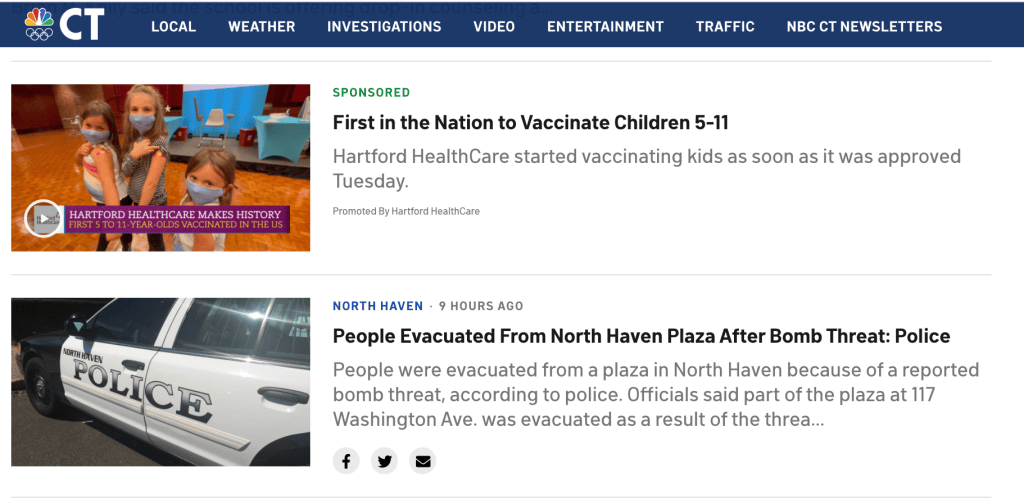
Keeping with the example of native advertising, these ads look exactly like articles that would appear on a news site. See the example above from NBC CT. It’s very easy to overlook the “Sponsored” flag at the top of the article, and advertisers name the light gray small font below.
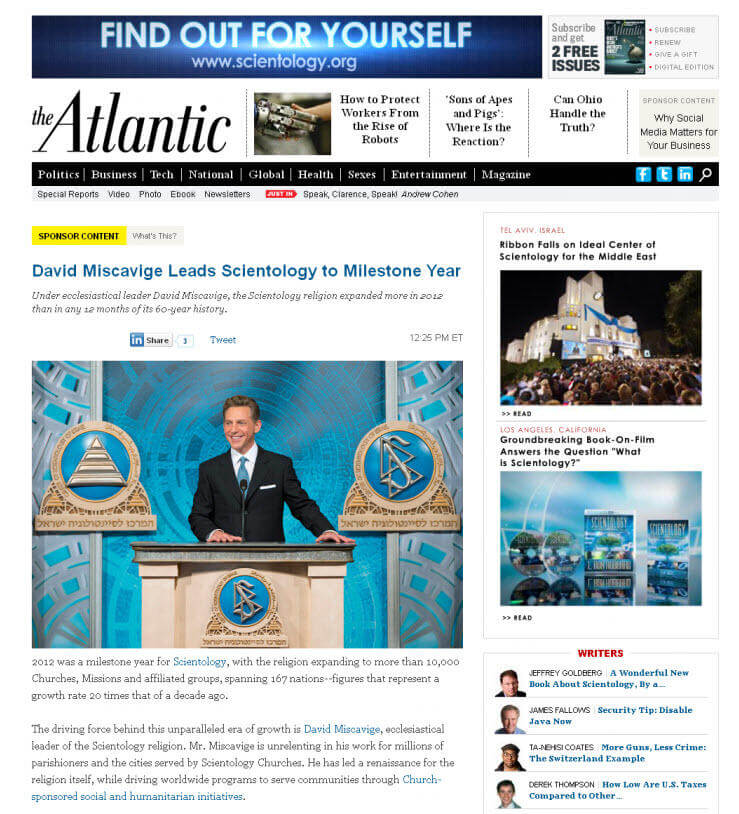
Because native ads mainly appear on news websites, when a person clicks them thinking it’s a news article, they begin to lose trust in the new organization. For example, The Atlantic posted a native ad for the Church of Scientology, which boasted the ‘milestone year’. The news site quickly pulled the ad but still received much criticism from its audience. The Atlantic has since revised its advertising policy
Another avenue where content can be mishandled is on social media. Anyone can post on YouTube, Facebook, Tictok, etc., with little to no consequences. Regular people do not have to follow FTC guidelines. Other followers may police their posts are even the social media sites themselves but for the most part, users can post and share whatever they wish. Unfortunately, this is how the spread of misinformation happens. The coronavirus pandemic was riddled with public confusion, and people did not know who to listen to. There were posts giving recipes containing common spices that could cure the virus. Then scammers were posting fake covid-19 test kits or trying to sell chloroquine. The social media companies could not block them all. These unverified posts only distracted and made it more difficult for the medical community to get the correct information out to the public.
The Ugly
The fundamental goal of every online business is to get people to their website and keep them there with the end game of having users see ads or purchase an item or service. However, the tactics used could be less than ethically sound.
One way businesses coerce the desired action is through “dark patterning.” Dark patterning is “ways in which software can subtly trick users into doing things they didn’t mean to do or discouraging behavior that is bad for the company.” Examples of this include forcing users to subscribe to a site before entering or making it difficult to unsubscribe from a site or service. Often users get upset and frustrated and abandon the process. If it’s a paid service, they continue to pay their monthly subscription, which is terrible for the user, but the company gets what they want.
Another example of dark patterning can be found in SEO. Web pages can be indexed or blocked from search engines, so users can’t search for the pages they are looking for. For example, Turbo Tax was found to have blocked their free tax filing page from google searches. Instead, all users including those eligible to file for free were forced to go down the path to pay turbo tax $60 – $120 to file their taxes.
In addition to dark patterning, the latest tactic in deceptive content is deepfakes. “Deepfakes use deep learning artificial intelligence to replace the likeness of one person with another in video and other digital media.” So when a person’s image and voice are rendered unmistakably on another person, how are people to know what’s a real video and an altered one? This technique was used in movies including Furious 7 when Paul Walker died, and the producers had his brother act out the final scenes then overlay his face and voice.
Because the deepfakes are so realistic, the Pentagon is working on getting ahead of the problems they can pose to society. The government has serious concerns that if the likeness of a president is used to state falsehoods it could be a national security risk. Currently, the Pentagon is investing millions of dollars into technology that can detect deepfake in the hopes that it will differentiate fake audio and visuals from the real thing.
A Possible Solution
Where does this leave us as a society? Whose responsibility is it to uphold ethical standards? Because it’s impossible for the FTC to catch every piece of misinformation, the responsibility falls on advertisers, content creators, companies accepting advertising dollars, and people consuming the conten- all of us.
Writer Jamie Indigo suggests we a take piece of Immanuel Kant’s philosophy and ask these two questions before publishing:
- Can I rationally will that everyone act as I propose to act?
- Does my action respect the goals of human beings rather than merely using them for my own purposes?
If the answer is ‘no’ to either question, revise the content, or don’t publish, it’s not ethically sound. On the other hand, if you have read or watched misleading and deceptive content, it must be reported. Don’t just email the company directly, post publicly to get your voice heard. To make sure we can keep the line of truth and fiction well defined, we must uphold ethical standards.
References
Ali,S. Harris and Kurasawa, Fuyuki. (2020). #COVID19: Social media both a blessing and a curse during coronavirus pandemic. The Conversation. Retrieved from: https://theconversation.com/covid19-social-media-both-a-blessing-and-a-curse-during-coronavirus-pandemic-133596
Balarin, Gina. (2021). With Great Content Power Comes (Yep) Great Responsibility – What Will You Do With It. Content Marketing Institue. Retrieved from:
Bump, Pamela. (2019). The Ultimate Guide to Sponsored Content. Hubspot. Retrieved from: https://blog.hubspot.com/marketing/sponsored-content-that-doesnt-suck
Farid, Hany. (2018).The dystopian digital future of fake media. Quartz. Retrieved from: https://qz.com/1383619/the-dystopian-digital-future-of-fake-media/
Conic, Hal. (2019). 6 Ways to Make Your Native Advertising More Ethical. American Marketing Association. Retrieved from: https://www.ama.org/marketing-news/6-ways-to-make-your-native-advertising-more-ethical/
Indigo, Jamie. (2019). What Is Ethical SEO? Search Engine Journal. Retrieved from: https://www.searchenginejournal.com/what-is-ethical-seo/318483/
Manssor, Hassan. (2019). Why is Advertising Important? 9 Reasons Why You Really Do Need It. Business 2 Community. Retrieved from: https://www.business2community.com/marketing/why-is-marketing-important-9-reasons-why-you-really-do-need-it-02186221#:~:text=Marketing%20informs%20your%20customers%20about,makes%20the%20business%20stand%20out
Native Content Atlantic – Scientology. (2014). Retrieved from: https://www.wordstream.com/blog/ws/2014/07/07/native-advertising-examples
O’Sullivan, Donie. (2019). When Seeing Is No Longer Believing. CNN. Retrieved from: https://www.cnn.com/interactive/2019/01/business/pentagons-race-against-deepfakes/
Ravenscraft, Eric. (2020) How to Spot—and Avoid—Dark Patterns on the Web. Wired. Retrieved from: https://www.wired.com/story/how-to-spot-avoid-dark-patterns/
Photo by Matthew Henry on Unsplash
 To Mulberry Street Marketing & Design
Leave a comment