

Have you ever been caught in the endless game of “Why?” from a toddler? Although this game can be annoying at times, it’s a helpful way for curious children to learn how the world around them works. Similarly, the Five Whys problem-solving method keeps asking ‘Why” until the root cause of a problem is found. The practice of repeatedly asking the question “why” is simple, yet answering challenges a person to dig deep and think about the underlying cause. Often, the reason is not what you might expect.
“This is a simple but powerful tool for cutting quickly through the outward symptoms of a problem to reveal its underlying causes so that you can deal with it once and for all.”
Mind Tools
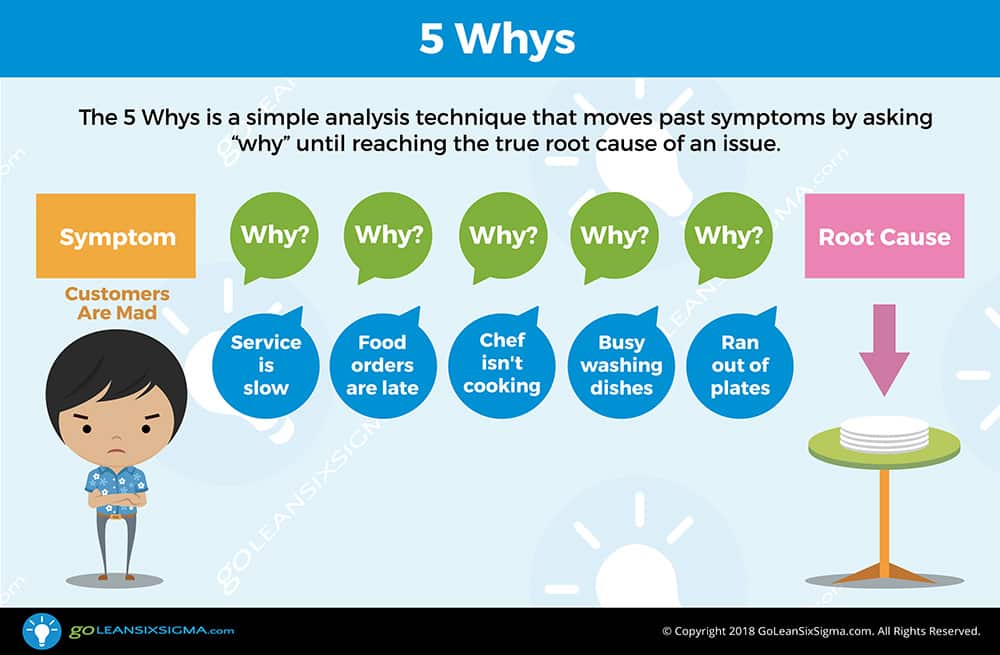
How to Perform 5 Whys Analysis
Even with the simple technique of repeating “why” five times, there are some guidelines to follow.
Gather a team. Bring people together who are familiar with the problem at hand. To gain a different perspective, invite people from various roles. Next, assign one person to be the facilitator to ask the questions, document the answers, and know when to end the session.
Define the problem. Everyone on your team must agree with the problem that needs to be solved. The issue must be clear and not too broad to not derail the exercise.
Begin asking why. Make sure the answers are specific and factual, not emotional. Have the facilitator record all answers.
Continue asking why. Reframe each why with the last answer given. Keep the conversation moving quickly to get the most honest answers.
If the conversation moves in multiple directions, a branching matrix can be developed. Then the team can travel down each path separately. This may reveal organizational issues that need to be addressed simultaneously.
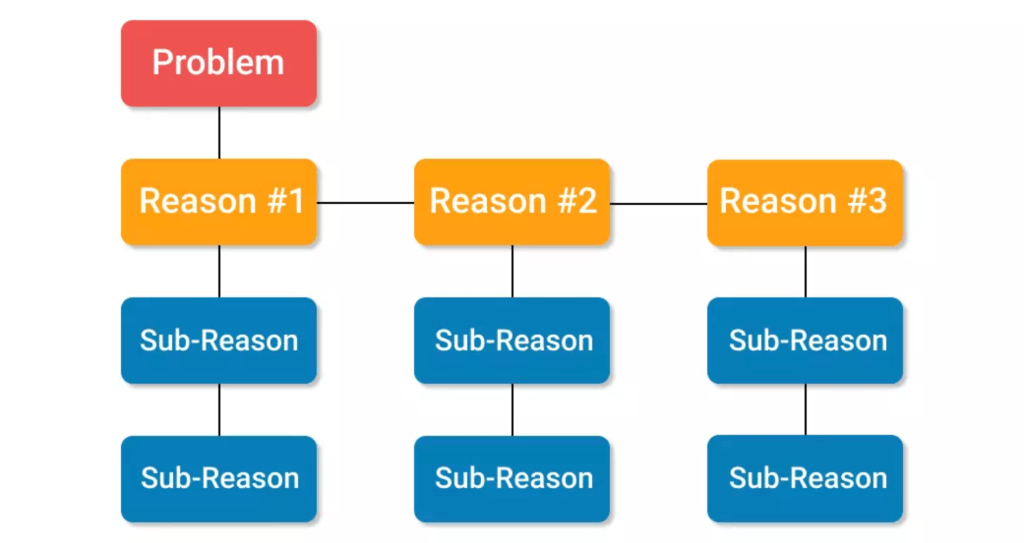
When to stop. Often, there is a natural stop where no more helpful answers can be given. It may even end with the response of “I don’t know.” Getting to this point may only take 3 whys or 7, the number 5 is a general rule, but it’s up to the facilitator and the team to recognize the final useful response.
Form a plan. Armed with the root cause, the team can now form a plan of action to remedy the problem. Include steps to monitor the progress of the solution as well future check-ins. If the answer isn’t working, meet with the team and repeat the process. Make sure to document all of the steps for reference or share with the company.
Recently, my team and I have been having price issues. We decided to try the 5 Whys to get to the root cause of the issue.
Problem: The price tags were released with the wrong pricing printed.
Why 1: Why was the pricing wrong?
Answer: The source price file contained multiple retail prices, and it was confusing to understand which was the correct retail price.
Why 2: Why does the price file contain multiple retail prices?
Answer: Multiple people work on the same document, and each product category is formatted differently.
Why 3: Why is formatting different?
Answer: Certain product categories have to be priced differently, and there is no standard.
Why 4: Why has a standard never been developed?
Answer: Because the original creators use whatever version they receive from headquarters.
Why 5: Why do they use what’s from headquarters
Answer: Because it’s easier to use the provided file instead of taking the time to reformat it.
Why 6: Why not take the time to reformat the file?
Here is the natural end to this 5 Whys exercise.
After our analysis, it was not expected that the reason for incorrect price tags would be from a poorly formatted price file. With this insight, the team and I can now plan to remedy the price tag problem by speaking to the price file creators and establishing new standards.
Wrapping up
When something goes wrong, it’s normal to ask why, but often the first why doesn’t provide the complete picture. By digging deeper and using the 5 Whys method, you can find the true cause. Also, by working with a team, everyone agrees on the problem, cause, and how to remedy the issue.
References:
Determine the Root Cause: 5 Whys. iSixSigma. Retrieved from: https://www.isixsigma.com/tools-templates/cause-effect/determine-root-cause-5-whys/
5 Whys. Interaction Design Foundation. Retrieved from: https://www.interaction-design.org/literature/topics/5-whys#:~:text=The%205%20Whys%20method%20is,causes%20and%20explore%20effective%20solutions.
5 Whys: Getting to the Root of a Problem Quickly. Mind Tools. Retrieved from: https://www.mindtools.com/pages/article/newTMC_5W.htm#:~:text=The%20method%20is%20remarkably%20simple,prevent%20the%20issue%20from%20recurring.
5 Whys: The Ultimate Root Cause Analysis Tool. Kanbanize. Retrieved from: https://kanbanize.com/lean-management/improvement/5-whys-analysis-tool
McNeil, P. and Pannafino, J. 2017. UX Methods: A Quick Guide to User Experience Research Methods. CDUXP LL.
 To Mulberry Street Marketing & Design
Leave a comment