
Maybe you have a big idea, or the company you work for is looking to create something that’s never been done before. Enter backcasting, a User Research method that takes radical visions and plans to make them happen. “Backcasting is the process of taking your vision of the future and figuring out a strategy and tactics needed to achieve it.” States Ryan Chen, Executive Director of Design Innovation Strategy at Bressler Group a product innovation company. This method is not only used for UX but in start-ups and companies looking to make breakthrough innovations such as Tesla and Amazon.
What’s the difference between Backcasting and Forecasting?
Although the basic idea of planning is the same in forecasting and backcasting, there are major differences. First, forecasting is solely based on past metrics and makes small incremental steps. Backcasting is planning for future innovations- something that has never been done before. Some backcasting is based on existing research, but the focus is on creating a plan for a breakthrough idea.
How Backcasting works
- Start by gathering past research to gain useful insights. Also, look to emerging technology that could serve as a tool.
- Gather project stakeholders and people from your team.
- Have a facilitator guide the meeting. Be sure to determine how far in the future to plan for, will it be 5, 10, or more years? Have the facilitator ask questions regarding future technology indicators. What opportunities and risks is the team willing to take?
- Let the team brainstorm preposterous ideas to more plausible options. Then, discuss which options the team would like to move forward with and agree on one.
- With the core idea, work backward to establish necessary steps, resources needed, and the risks and benefits involved.
- Record and distribute the future plan. The team now has a reference tool to use while working on the project. This plan will help everyone stay the course.
Backcasting in Action
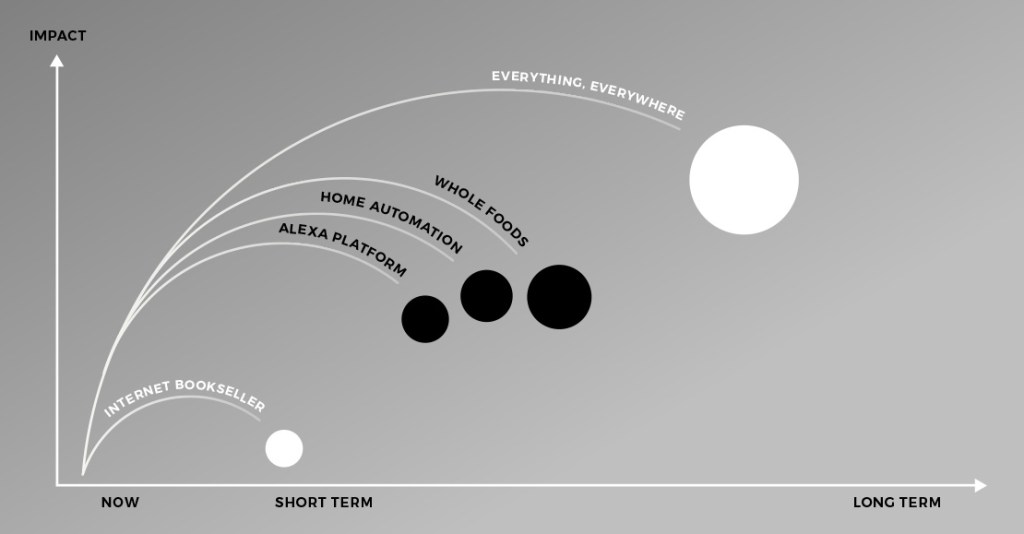
As mentioned above, Backcasting is used in more fields than UX and Amazon is an excellent example of planning out a big idea. For example, Jeff Bezos wanted to create a “customer-centric company, where customers can find and discover anything they might want to buy online.” Selling books was the first step. Since then Amazon evolved and created Alexa, home automation, then acquired Whole Foods. Each was a massive step that worked toward their goal of “serving all aspects of consumer life in the future.” Today, Bezos continues on this path and is even working toward creating commercial means to transport people into space.
A second example of backcasting is from the niche app called Tala. Mainly used in Africa, Tala is a credit scoring and money lending app. The founder, Shivani Siroya, researched people’s spending habits from Africa and India and found those who were deemed as high risk by banks could actually be trusted to repay loans. From this insight, and the desire to help those in need, Siroya gathered a team to bring her idea to life. One major step they took was to develop a way to measure a person’s creditworthiness by collecting data solely from their mobile devices. The next step was to figure out where to release the App. Through more research, they found emerging markets like Kenya would work because they had significant growth in smartphone subscriptions and mobile money adoption was on the rise. Siroya’s idea took off, and Tala expanded to more new markets.
Using Backcasting
Although running a backcasting workshop requires very few tools, only sticky notes, pens, and a whiteboard are necessary, the process and foresight to develop a future innovation is challenging. Jon Blackwell, who helped start Tala, states, “Tala’s path to becoming a digital lending tool was haphazard, messy, and lucky.” In other words, backcasting helps determine a shared vision and lays out the necessary steps, but can be a disorderly process.
Final Thought
Backcasting is a great way to open your mind and think big long-term picture. The plan and steps created are rough ideas but the payoff is great. You are essentially working to create a breakthrough product. Mike Maples Jr. said it best: “The future doesn’t happen to us; it happens because of us.”
References
Blackwell, Jon. A Backcasting Case Study: Tala. Jon.Blackwell. Retrieved from: https://jon-blackwell.com/blog/a-backcasting-case-study-tala
Chen, Ryan. (2020) How ‘Forecasting and Backcasting’ Enable Disruptive Innovation. Bresslergroup. Retrieved from: https://www.bresslergroup.com/blog/design-defined-forecasting-and-backcasting/#:~:text=Amazon%20is%20one%20example%20of,a%20path%20to%20disruptive%20innovation.&text=This%20is%20an%20example%20of,desire%2C%20rather%20than%20on%20analysis.
Field, Genevieve. (2019) This Founder’s Journaling Obsession Made Tala an $800 Million Business. Marker.Medium. Retrieved from: https://marker.medium.com/this-founders-journaling-obsession-made-tala-an-800-million-business-ea9245469734
Maples Jr. Mark. (2020). How to build a breakthrough…the secret of Backcasting. Medium. Retrieved from: https://medium.com/@m2jr/how-to-build-a-breakthrough-3071b6415b06
McNeil, P. and Pannafino, J. 2017. UX Methods: A Quick Guide to User Experience Research Methods. CDUXP LL.
Wilson, Chauncey. (2011). Method 16 of 100: Backcasting. Designing the User Experience at Autodesk. Retrieved from: https://dux.typepad.com/dux/2011/08/method-16-of-100-backcasting.html
 To Mulberry Street Marketing & Design
Leave a comment